
On the 23rd of April Garrelt and Thorsten attended the ISIG Quantum Computing Infra Summit in Silicon Valley, USA. At the event, Garrelt introduced our views on utility grade quantum chip testing equipment drawing on insights from our recently released white paper.

About the white paper
The transition toward commercial quantum chip production is signalled by a series of landmark developments across the quantum ecosystem. These developments demonstrate that quantum hardware is no longer confined to academic proof-of-concepts but is increasingly shaped by engineering-driven scaling strategies. The full white paper provides further detail.
Challenges of commercial quantum chip production
Identifying the critical process steps in quantum chip development cycles and knowing their impact or influence on the quantum chip performance is the key challenge for all qubit modalities. Another challenge for commercial quantum chip fabrication is the resource-intense determination of quantum chip performance. More broadly, the community recognizes the lack of a well-established quantum-focused Process Design Kit (PDK) as a major hurdle to manufacturing quantum chips at scale. Certain building blocks of such future quantum PDKs are currently under development. OrangeQS highlights that such future quantum PDKs also need to contain a Process Control Kit (PCK).
Towards developing a quantum Process Control Kit
In control theory, the concepts of ‘observability’ and ‘controllability’ define whether the underlying physics of a process can be effectively monitored and manipulated using available sensors and actuators. Due to the limited ability to directly observe the quantum device performance, often only measurable at high costs, and to influence critical parameters in the quantum chip fabrication process, the observability and controllability of quantum production processes are markedly constrained.

Overview of automated test equipment (ATE) for different stages of quantum chip fabrication. Quantum chip performance (Qubit testing and QPU benchmarking) can only be measured at high costs.
Lessons learned from the chemical process industry
The challenges of limited observability and controllability of a production process closely resemble those faced by the chemical process industries. Rather than relying solely on direct measurement, these industries employ process models, with varying levels of prediction fidelity, ranging from first principles physics to empirical and data driven representations to infer system state and guide control actions. In its most advanced form, this philosophy has given rise to the concept of the “lights out factory”: a highly automated production environment that operates with minimal human intervention.

Basic model-based control loop diagram, drawing inspiration from the diagram frequently used in the process industry
Towards a ‘lights out quantum foundry’
The first step toward a ‘lights out’ quantum foundry is to ensure that informative data is available for optimisation. Once collected, data must be stored and handled in a consistent, traceable manner across the entire production chain. With a robust data source, infrastructure, and management foundation in place, AI and machine learning models can be employed to map feasible operating windows, identify sensitivities, and predict performance outcomes under uncertainty.

Artist impression of a ‘lights out quantum foundry’
Lighthouse for the emerging quantum chip value chain
The visionary concept of a lights out quantum foundry can be realised through a value‑chain approach in which aligned incentives create a self‑steering mechanism: by maximising total industry value, the necessary technological developments and organisational alignments naturally follow. By adopting this approach, the industry will be able to realise the transformative capabilities of quantum computing hardware, establishing the foundation for subsequent technological progress and facilitating the integration of pivotal innovations into society.
MAX Partnership Program
The paper also highlights the importance of focused, well‑scoped collaborations within specific parts of the value chain. Initiatives such as the OrangeQS MAX Partnership Program demonstrate how targeted cooperation, centred on access to high‑quality quantum chip performance data, can improve feedback between manufacturing, testing, and design. These collaborations serve as practical building blocks towards scalable quantum chip manufacturing and the broader integration of quantum technologies into future applications. The OrangeQS MAX Partnership Program will initially focus on parallel and non-destructive testing technology developments.
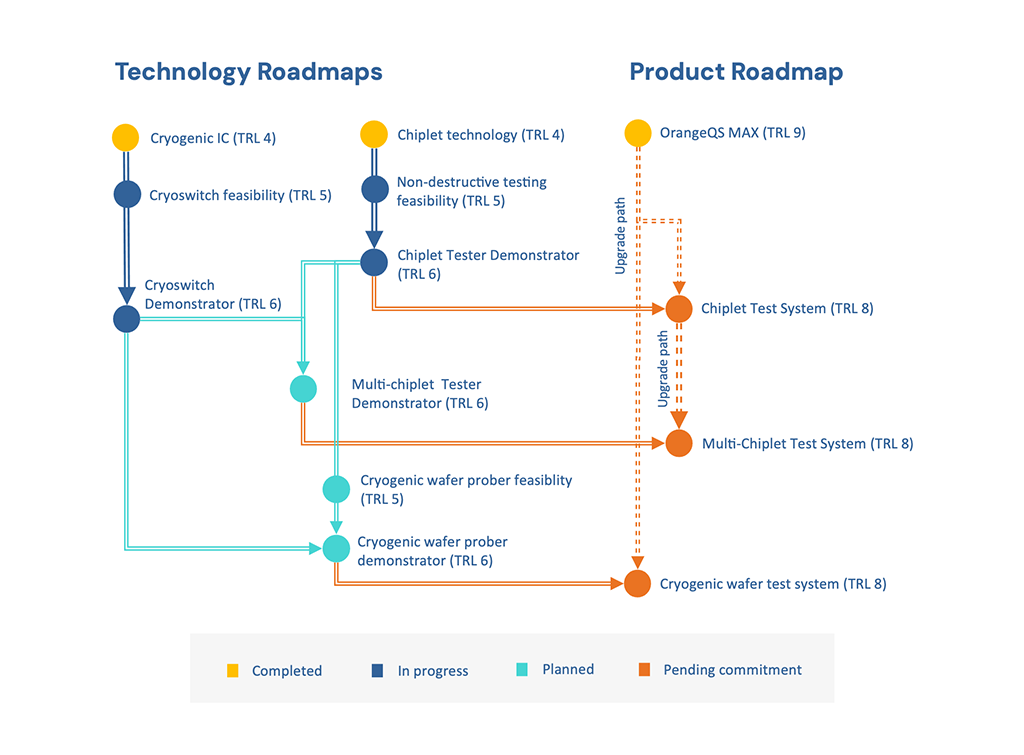
Technology and product roadmaps
View white paper
Click the button below to view the full white paper.


